
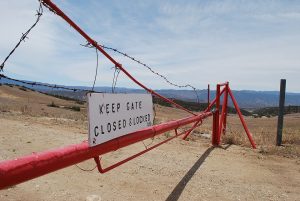
Boundaries can be held in the physical form, like fences or doors, and the borderlines around countries in the world.
Boundaries can also most certainly be important in the personally meaningful form, like awareness of personal space, telling truths, and not stealing others’ belongings – this 3rd example showing where physical form nestles closely with emotional reaction and personal meanings. And herein lies the respect aspect of boundaries; in respecting that others have the right to own belongings, the choice is thus made to not steal those belongings from them, because to steal is to disrespect others rights and their space in this physical world.
These two terms, boundaries and respect, are for me intertwined; if a boundary is breached, there mostly is some level of disrespect inherent.
However, it might depend on where and how the breach occurred; where an elderly person becomes known for shouting at children who run past their house, that might be viewed as a skewed boundary, especially where the children are simply playing, running along the public pavement and not setting foot on or damaging the elderly person’s property at all.
Yet, for that person, perhaps the happy yelling, the playful chants, the exuberance of youth, whilst not even aimed At Them, might intrude upon their need for quiet because they are full of hard-to-feel emotions, and that sound-intrusion might be perceived as disrespect and prompt the efforts to keep that boundary; the kids get shouted at.

We can place much effort in trying to hold our boundaries, and this can use up a lot of our energies if the boundaries are too flexible, get pushed about so much as to be unreliable, and need constant monitoring and reinforcing.
Imagine if a farmer had a wobbly fence around a field of angry bulls, and if he didn’t know how to fix it, he’d be constantly going round checking it lest the bulls get out and cause havoc, and he’d never get anything else done. Imagine also a person in a care home, finding their door suddenly opened without a courtesy knock first…umpteen times a day…and perhaps through the night too…
Sometimes where there is precious little rational energy left, “digging deep” to try to rustle up some effort, where the boundary breach is felt to be important enough to require every effort possible, this might incur the use of anger energy.
I have born witness to tales of so many situations where the boundaries have been disrespected so often, from such a young age, that even the possibility of boundaries is lost.
The child, who, needing love and care from their parental figures, instead experiences hatred, neglect, or outright abuse. In not being shown any level of reasonable respect as a child, how can that person grown into adulthood know what respect or boundaries are all about? That person, as an adult, might find themselves reacting with anger to most things, even things that others might consider trivial – because maybe the healthy boundaries of personhood were never learnt, so every approach brings unknown danger to themselves, and prompts anger as the final effort of self-protection.

The elderly person living in fear and shouting at children playing… the young man, raised in a household of verbal abuse, drunkenness and violence, either watches in confusion as life plays on around him or gets involved with his own fists, drinking sessions, and reputation…. whilst perhaps screaming inside, crying silently, for just someone to love him and accept him.

So many young people in the prison environment, not knowing respect, mistakenly trying to gain respect by being The Big One, using the anger that everyone recoils from, misinterpreting that recoil of fear as being evidence of respect…
So many who search for a meaningful place, a belonging in the world, find themselves joining the armed forces. So often advertised as ‘join our big family’, ‘come have adventures with us’, and ‘belonging’… the armed forces are certainly useful for channelling that anger energy when firing lethal weapons, yelling orders at others who are duty bound to obey, and running and running until your lungs might burst…
But when your service days are done, no matter your exit means, whether honourable or otherwise, what then?
Do you now need to address the issues that saw you heading towards that environment where violence is not only accepted, but required and nurtured? How do you do that? And stay off the radar of law enforcement in civvy street? The boundaries held in normal life are different to service life. If you left civvy life to escape – domestic violence, neglect, responsibility – how do you manage the return?

I have also borne witness to tales where anger is absolutely justified and reasonable.
Those times where a person finds that some in their circle are repeatedly demonstrating disrespect; where money is owed and not paid despite strenuous efforts to assist the payment; where late night phone calls carry on in the face of being asked to not disrupt much needed sleep; where a parent shuts-down the adult child by means of lies, playing one off against the other and blaming everyone and everything else for their woes except themselves; where as a grandparent you can’t plan your own life because you find your days filled with unannounced and un-agreed baby-sitting duties; where in your care home your door is no barrier to repeated unannounced intrusions … there are times when anger is reasonable, and then comes the tricky manoeuvre of how to address the issue that is making you angry, notice what it is, before the anger gets such a head of steam that it gets you into trouble, or just adds to the mix.
Do you stop visiting that parent who demeans you so much? What does that mean, to both love and hate a parent? Do you give the debtor one last chance before filing at Small Claims Court? Do you write off the debt? Do you change your phone number and ensure the night caller doesn’t have your new number? Or turn your phone off? Do you sit your children down and explain and agree a rota? And if that doesn’t work…? Do you have a sign made to put on your door asking people to knock first and await an answer before coming on in…?
All these, and more, are what can and often is explored in counselling.

How to recognise what is happening around you, how to figure out what is and isn’t your responsibility, and how to manage boundary incursions when they happen again and the emotional fallout from those continued incursions…. Because they will, because people are forgetful, life is also real busy for them too, and sometimes it’s OK to notice the breach and understand that it was due to a very good forgettery and wasn’t, this time, a repeat of well-known abuse aimed at you personally.
But if it is….
Rosalyn Young is a qualified mental health nurse with 30 years
Experience in govt and private agencies helping those in crisis
and in recovery. She has studied counselling to degree level,
and specialises in working with survivors of childhood abuse
and neglect, PTSD, DID, and emotional regulation problems.
She lives in Lincolnshire with her husband and a variety of
companion animals, is a brewer of mead, and student of
growing things in the garden.


